Friday, June 29, 2018

CVS: Downright Undervalued And A Great Pick For Your Portfolio

I believe that CVS Health (NYSE:CVS) is downright undervalued and is trading at a discount of 57%. The completion of the Aetna (NYSE:AET) acquisition would solidify revenue growth and allow CVS to diversify its streams of revenue. Such an acquisition could certainly provide the groundwork for larger revenue growth as well as an increase in long-term debt.

How is CVS growing?

CVS is the largest retail pharmacy in the United States, currently boasting nearly 20,000 pharmacies. As the US population ages and grows, the demand for pharmaceutical prescriptions is rising. Based on listing prices, spending on pharmaceuticals in 2016 totaled approximately $450 billion. This spending on prescriptions is expected to accelerate and total approximately $600 billion by 2021, which would allow CVS to capitalize, considering approximately 45% of its revenue is generated through filling prescription medications.

The AET acquisition would mean the absorption of the 3rd largest health insurer in the United States. This would allow for cheaper prescriptions as CVS's pharmacy benefit management, which allows CVS to negotiate prices with different insurers, would lower prices for those insured by the health insurance wing of the pharmaceutical retain giant. There are currently 22 million Americans insured by AET who would then have the price incentive to fill their prescriptions at CVS. Currently, AET brings in approximately 60$ billion annually, and that is projected to rise at an average of 5% through 2022. This extra income can help CVS diversify its revenue streams and pull ahead of its competition as it faces threats in Walmart (NYSE:WMT) and Amazon (NASDAQ:AMZN).

Debt Problems

Current long-term debt for CVS sits at $65.1 billion, which was ballooned through CVS's attempt to acquire AET. CVS's credit rating sits at Baa1. However, Moody's Investor Services have held CVS's credit rating on review, and the result could very well end in a Baa2 rating, approaching junk bond territory. The operating cash flow for CVS covers approximately 10% of current long-term debt, which sits below the normal healthy amount of debt, 20%. Despite this, I believe that CVS is still financially stable. However, the cost will dampen cash flow and hurt CVS. EBIT coverage on necessary interest payments is approximately 8.4x. CVS has the ability to pay down its long-term debt and, as a result, raise its cash flow.

Competition

CVS will still continue to face competition from Walgreens (WBA) and Rite Aid (NYSE:RAD). However, it is other companies that may pose a bigger challenge in the near future. WMT is currently in early-stage acquisition talks with Humana (NYSE:HUM), which would allow WMT to effectively compete with CVS, assuming their respective mergers are approved. WMT has recently received a patent on blockchain technology-based data systems for medical records. This is significant because this technology that WMT has patented could allow first responders to access medical information of people who are unable to communicate. HUM is currently the fourth largest health insurance company in the United States, bringing in $54.3 billion in net revenue. AMZN has begun to enter the healthcare market through a partnership with Berkshire Hathaway (NYSE:BRK.A) and JPMorgan (NYSE:JPM). This new venture aims to reduce the cost of healthcare services by cutting out middlemen and other sources of waste. Dr. Atul Gawande was named the CEO of their newly formed healthcare company. A large part of their strategy seems to be going after pharmacy benefit management, which would mean that CVS would have to lower prices in order to compete, at the very least.

Valuation

According to my discounted cash flow analysis, CVS is trading at a discount of 57%. I've projected sales growth at an average of 6% over the next 5 years, which accounts for growing threats in the PBM and retail industry. This growth will heavily be a result of the growth in prescriptions and the need for them to be filled.
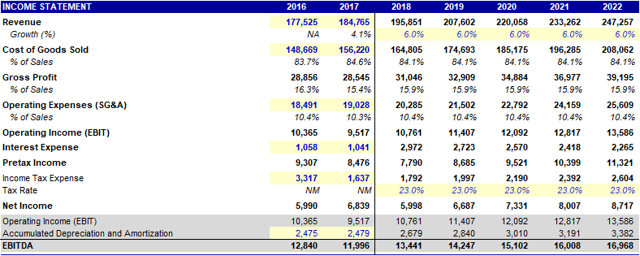
This leads me into my discounted cash flow model, in which I use the perpetuity growth method. I've calculated by beta through monthly comparison with CVS and the S&P 500 since 2012 and assumed a growth rate in perpetuity at 2%.
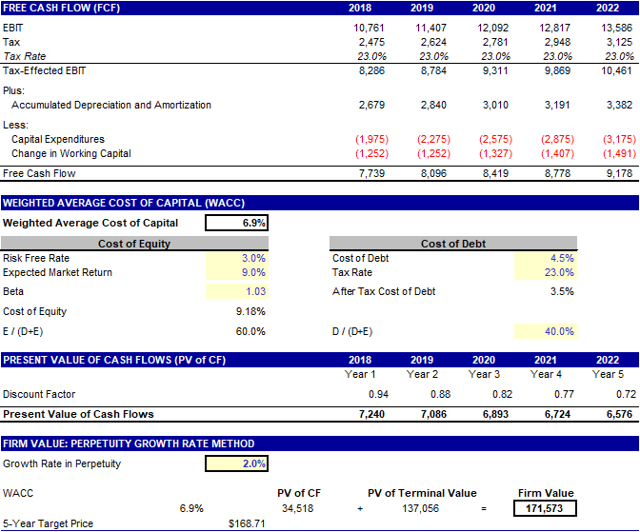
At a WACC of 6.9%, CVS is extremely undervalued and is trading well below what it should be considering its future outlook. Free cash flow will steadily rise and prove to raise the company's valuation.

CVS's P/E ratio is 10.8x, which is well below the healthcare industry average of 21.9x and the current market average of 18.4x. This is yet another example of how CVS is trading at a discount.

Note that this valuation does not take into account the prospective AET merger, which would fundamentally change CVS and assuredly provide a more weighted valuation.

Dividend Yield

Current dividend yield sits at 2.83%, resulting in $2 per share. Current analyst projections point to a dividend yield growth to 3.55% by 2021, which could yield $2.51 per share. This dividend yield is not particularly high in comparison with the market as a whole. However, someone looking to diversify their income investing portfolio could look to the pharmaceutical retail industry, and CVS stands out in that regard as they boast a higher dividend yield than its closest competitors WBA and RAD (as RAD does not pay dividends).

Conclusion

I believe that CVS is extremely undervalued at its current price, and there is a large amount of upside that CVS will see if regulators approve the AET deal. The dividend yield that CVS offers is simply a cherry on top to the rest of CVS's strengths. While there are some growing pains that CVS suffers from their on-boarding of debt, I believe CVS can handle its debt levels well and provide strong growth over the next 5 years, allowing CVS to reach its fair value.

Disclosure: I/we have no positions in any stocks mentioned, but may initiate a long position in CVS over the next 72 hours.

I wrote this article myself, and it expresses my own opinions. I am not receiving compensation for it (other than from Seeking Alpha). I have no business relationship with any company whose stock is mentioned in this article.

Additional disclosure: Note: I am a sophomore at The University of Alabama. Please leave any criticisms, corrections, or notes to help me better my overall investing acumen in the comment section below. Thank you for reading my article!

Sunday, June 24, 2018

4 Financial Tips for Empty-Nester Dads

The dispensing of advice is a paternal tradition: Dads pretty universally like to stick their two cents in. So, in honor of Father's Day, Alison Southwick and Robert Brokamp are dedicating an episode of�Motley Fool Answers to giving some back, with money tips for men at three different stages of their parenting careers.

In this segment, it's advice for fathers whose offspring have, relatively recently, become adults themselves. For these proud parents, the hard work of launching the children may be done, but they may have been letting a few other things slip during the final stretch of that marathon. And the areas where you may want to make changes may only indirectly be about your finances.

A full transcript follows the video.

This video was recorded on June 12, 2018.

Alison Southwick: What's your advice for the golden dad? Is this the empty nester?

Robert Brokamp: This is the empty nester. It could be anyone from their mid-50s all the way up into their 80s or 90s. But, basically the dad that is still a dad, but no longer has the kids at home. They may be retired or close to it, certainly within the home stretch there. For these folks, at least according to the Federal Reserve, the median income of people in the age range of 55-64 is $57,876. So, it is down from the previous age group. The median net worth is $187,000. These are folks who are getting close to retirement and, for many of, they really haven't saved enough.

So, what should you do? Let's start with retirement, of course. It's time to get that professional retirement checkup, again. But part of it, too, is also deciding what you want to do with the rest of your life. Do you want to retire? Do you want to try a second job? The fastest-growing segment of the population that's starting their own businesses is people over 50. Do you want to go back to school? That has to be all part of the retirement plan, not just whether you've saved enough.

Southwick: And that requires soul-searching, not just a sit-down with a financial advisor.

Brokamp: Exactly. A good discussion with your spouse, maybe a career coach, something like that.

N0. 2, get professional tax help to understand how your tax bill is affected by the new tax law, and how it will or has been affected by retirement. Tax rates are down, the new tax law has made a few changes in terms of what you can deduct. It's really good advice for anybody to sit down with, maybe, a good tax pro -- especially at this time of year, they're not so busy, they have some time -- just to understand that.

But it's particularly important for people who are getting close to retirement, because the whole tax scheme changes. When you're working, you get your paycheck. That's by far the No. 1 source of your income, and you pay ordinary income taxes on that. You can't get around that. You can take some deductions here and there, but that's it. When you're retired, everything changes. You have Social Security, which could either be free of taxes or only partially taxed. You have different accounts, taxable account, traditional Roth. You determine where you're going to take your money from, and each one has a different tax consequence. You're selling investments, that has tax consequences. You could buy bonds like municipals, treasuries, and corporates. Each one of those are taxed differently. It gets more complicated. Plus, when you're working, you're used to your employer taking money out of your paycheck and doing the withholding thing. When you're retired, you can do that or not. You can have some taxes withheld from Social Security, or you can do quarterly taxes, which is actually probably better for most people, but they've never done it before.

So, I definitely think, for those who are retired or getting close to retirement, they should see a tax pro to understand how all that changes. Taxes are just like every other expense. You want to lower them, and you have more opportunity and flexibility in retirement, so understanding that beforehand is a good idea.

No. 3, consider downsizing and what the Swedish call dostadning. I don't have a good Swedish accent.

Southwick: Oh, Engdahl is the one who's going to bring the Swedish.

Engdahl: [...]

Brokamp: [laughs] Well, it means death cleaning.

Southwick: Oh, really!

Brokamp: Yes. It's the process of radically decluttering your home so your children don't have to deal with it when you pass away.

Southwick: Actually, we're going to do an upcoming episode on death cleaning.

Brokamp: We are?!

Southwick: Yeah.

Brokamp: Based on the book that came out in January?

Southwick: No, based Lacey coming on the show, and her experience. I just talked her into it today.

Brokamp: Oh, excellent! Well, so, a book came out earlier this year, "The Gentle Art of Swedish Death Cleaning." Basically, let's face it, you've had this house, probably a bigger house. You've raised the kids, they've moved out. You've accumulated all kinds of junk over 20, 30, 40 years. It's a good idea to start going through that. No. 1, you can donate a lot, you can do something with that, do some good for the world. One thing you'll often hear is that you want to be able to give things to your friends and relatives with a warm hand rather than a cold hand.

Southwick: [laughs] Oh, wow! OK.

Brokamp: Meaning, if you're going to be passing along heirlooms --

Southwick: Oh, no, I got what it means! I got what it means!

Brokamp: [laughs] Why not do it now? You could sell stuff on Craigslist, eBay, whatever else, raise money that way. But, it really is, you don't want to be doing that when you're 90, you don't want to be doing that if your spouse has passed away and you're all alone doing it, and you don't want to leave that to your kids. So, now is a good time of life to be thinking about that. And if you have that big four-bedroom house, maybe it is time to downsize to a two-bedroom house. You'll probably pocket some money, as well as lower property taxes, lower utilities. It's something to consider.

Then, finally, No. 4, and this is probably more for older folks than people in their 50s, but, begin sharing your financial management, whether it's with a financial planner or a trusted relative. More and more research is coming out about, basically, how we age, how our brains age, and how that affects our ability to manage our finances as we get older. There's a research article by Michael Finke, John Howe, and Sandra Huston called "Old Age and the Decline in Financial Literacy." They basically gave a financial literacy test to people of various ages over a course of years, and they found, essentially, that financial literacy goes down about 1% per year after age 60. David [...] of Harvard has found that it affects about half the people by the time they're age 80.

Here's the thing, though. While financial literacy does go down, and cognitive decline starts to impair our ability to manage money, our financial confidence remains the same. People are very reluctant to acknowledge the fact that maybe they're unable to handle their money the way they used to.

So, while I don't think that this will happen to everybody, I think everyone should incorporate it into their retirement plan that this is a possibility, and you start building in safeguards into it now. That is, you start hiring a financial planner, start working with someone. Often, it's financial planners or relatives who notice some sort of change in financial management. All of the sudden, this 95 year old person calls in and says, "I want to cash out my IRA because I have this great idea to invest my money."

Southwick: "There's this guy in Nigeria, he's very trustworthy, and I'm very excited."

Brokamp: Exactly. Or, a trusted relative, and you give them power of attorney over the accounts, or something like that, just to build that in. Also, the other aspect of this, too, is -- and, it's often the husband, in this case, the father, who manages the broader financial planning things. What happens if something happens to you and your wife survives? Who's she going to turn to for financial help? It's better to build that relationship now rather than after you're gone and she's on her own and she has to figure that out. Of course, the flip side is also true. It could be that the wife is the one who does most of the financial planning and financial management, and she should do the same thing for her husband, because she could predecease him.